A freeze dryer does not work alone. In a real factory, it sits in the middle of a line that starts with raw material and ends with a packed, shelf-stable product. Each stage — washing, cutting, blanching, pre-freezing, drying, and packaging — affects the next, and the line only performs well when the stages are matched to each other. This guide walks through a complete freeze-drying production line and explains how the pieces fit together.
Stage 1: Washing and Sorting
The line starts with cleaning. Washing removes soil, grit, and surface residues, while sorting removes defective pieces before they reach the dryer. For leafy vegetables, a bubble washer is gentle; for root vegetables, a brush roller cleaner may be better. The goal is clean, consistent raw material with minimal water uptake, because excess water has to be removed later.
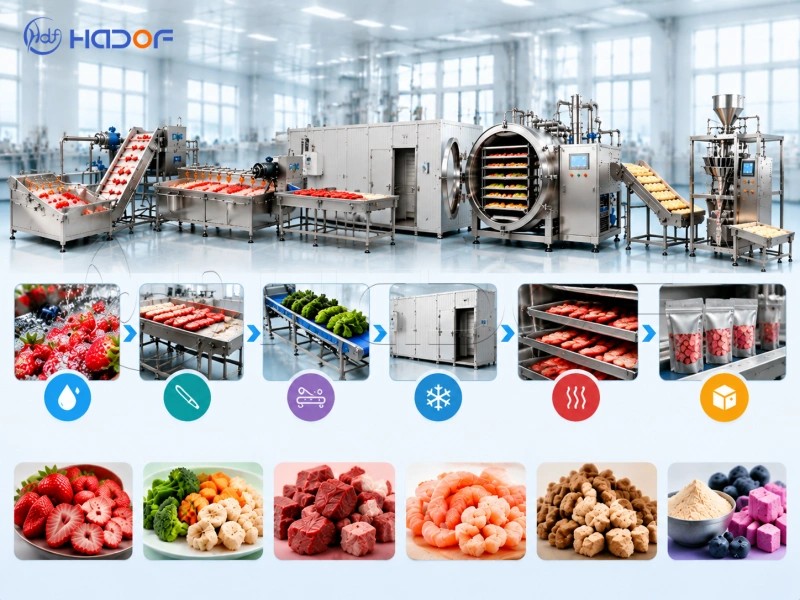
How a Complete Freeze-Drying Production Line Works from Washing to Packaging
Stage 2: Cutting and Preparation
After washing, the product is cut to a uniform size. Slice thickness and piece size determine how fast water can leave the product, so consistency here directly affects the drying cycle. A dicing or slicing machine produces even pieces, which dry at the same rate and look consistent in the final pack.
Stage 3: Blanching
Blanching is a short heat step that deactivates enzymes and helps fix color. For vegetables, it is often essential; for fruit, it may be optional. The process must be controlled, because under-blanching leaves enzymes active while over-blanching softens the product. A blanching machine with adjustable temperature and time lets you match the process to each product.
Stage 4: Pre-Freezing
The prepared product is frozen quickly, usually in a tunnel or IQF freezer. Fast freezing produces small ice crystals, which protect texture and make the freeze-drying process more uniform. Slow freezing creates large crystals that damage the product and lengthen the cycle.
Stage 5: Vacuum Freeze Drying
The frozen product enters the freeze dryer, where ice sublimates directly to vapor under vacuum. This is the core of the complete freeze-drying production line, and it is where most of the equipment cost and energy use sit. The dryer’s chamber, shelves, condenser, and vacuum system must match the product and the batch size.
Stage 6: Sorting and Packaging
After drying, the product is inspected and packed in moisture- and oxygen-barrier packaging. Sorting removes broken pieces and confirms quality, while packaging protects the product from humidity. For many products, metal detection and weight checks are also part of this stage.
How the Stages Fit Together
The line works best when each stage matches the dryer’s capacity. If the washer or slicer is too slow, the dryer waits; if the dryer is too small, product waits in the freezer. A complete production line is designed as one flow, with buffer space where needed and a clear sequence from dirty to clean. That is why layout and capacity planning matter as much as the individual machines.
Layout and Material Flow
The physical layout should follow the process, not the other way around. Raw material enters at one end, moves through washing and preparation, then into freezing and drying, and finally to packaging. Dirty and clean areas should be separated, and trays should not cross paths between stages. Buffer space between the slicer and the freezer, and between the dryer and packing, helps absorb small delays without stopping the whole line. A layout that respects this flow reduces handling, improves hygiene, and makes the line easier to expand later.
Capacity Planning Across the Line
Every stage should be sized to the dryer, not to its own ideal throughput. If the dryer processes one batch per cycle and runs one cycle per day, washing, cutting, and packing only need to support that daily volume with a comfortable margin. If the dryer runs continuously, the upstream and downstream equipment must keep pace. The most common planning mistake is to treat each machine as a separate purchase; the line performs well only when the slowest stage does not become a bottleneck. A simple capacity table, showing each stage’s hourly and daily output, makes the trade-offs visible.
Quality Checks Along the Line
Each stage deserves a simple check. After washing, inspect for visible soil and excess water. After cutting, check size uniformity. After blanching, check color and texture against a reference. After drying, check moisture and appearance. After packing, check seal integrity and weight. These checks do not need to be complicated; a short checklist and a few reference samples catch most problems before they become a full batch loss.
Common Mistakes
The first mistake is buying a dryer without planning the stages around it. The second is under-sizing washing or cutting equipment, which creates a bottleneck. The third is inconsistent slicing or blanching, which shows up as uneven drying. The fourth is poor packaging, which lets the product absorb moisture after drying. Finally, ignoring hygiene and cleaning routines can undermine an otherwise well-designed line.
Conclusion
A complete freeze-drying production line is a system: washing, cutting, blanching, freezing, drying, and packaging all have to work together. When they do, the line runs smoothly and the product stays consistent. HADOF Food Processing Manufacture designs complete lines built around its industrial freeze dryers, from pre-processing to packaging. Tell us your product and target output, and we will help you plan the right line.