A bulk blending line can give you a uniform fertilizer at the mixer outlet, yet the blend may look different by the time it reaches the bag. If one bag contains more large granules and another more fines, the issue may come from particle movement after blending.
Where Does Fertilizer Segregation Usually Start?
Look at the raw materials first. Urea, DAP, MOP and other granular ingredients may have different particle-size distribution, shape and bulk density. When the gap becomes large, smaller particles can move through spaces between larger granules during vibration or free fall, while heavier and lighter materials may follow different paths. This is a common form of particle segregation.
For your project, a precision fertilizer blending system can help control weighing and batching. Accurate dosing gives you the intended formula, while closer raw material sizes give that formula a better chance of staying uniform after discharge.
Does Longer Mixing Always Give You a Better Blend?
Not necessarily. Once the ingredients are evenly distributed, extra agitation may create more particle movement instead of useful mixing. The practical question is how long your formula needs to reach a stable blend without excessive rubbing or granule breakage.
This is where your compound fertilizer blending equipment configuration matters. Mixer type, rotation speed, filling level and discharge method can be selected around your granule condition and output.
What Happens Between the Mixer and the Bag?
Many segregation problems appear after mixing. Imagine a blended batch dropping from a high outlet, moving through conveyors and then falling into a storage hopper. Every transfer point gives particles another opportunity to separate.
In an industrial fertilizer blending plant, you can reduce unnecessary drop height, sharp transfer changes and long intermediate storage. A shorter material route means fewer chances for separation before packing.
When comparing layouts, pay attention to how material leaves the mixer, enters the conveyor and reaches the packing hopper.
Can Packaging Affect Blend Uniformity?
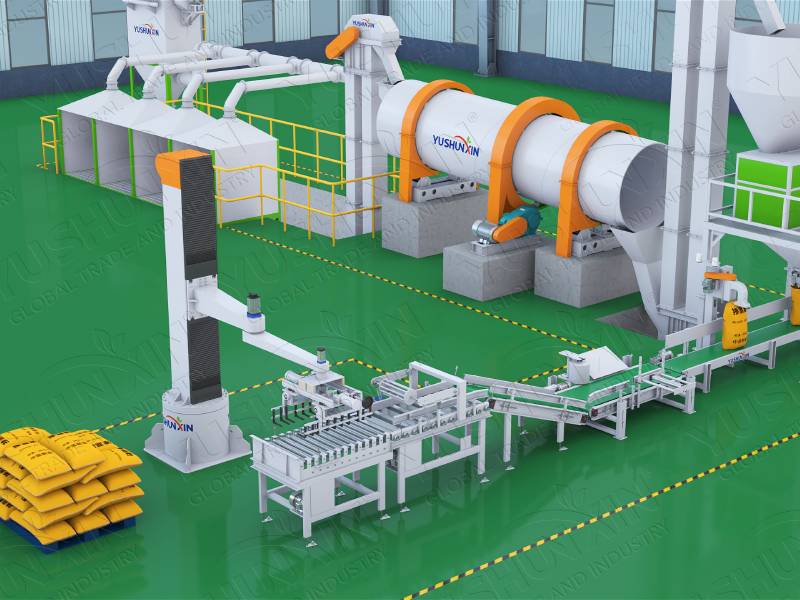
If fertilizer stays in a hopper for a long time or experiences repeated vibration before filling, the blend can gradually redistribute. Connecting blending directly with a fertilizer blending and bagging system can shorten the time between mixing and packing.
You can also compare bagging speed with mixer output. A balanced flow helps prevent material from waiting too long. Click here for more details about how blending, conveying and packaging can work as one continuous process.
Look at the Whole Material Route
If segregation keeps appearing, you do not have to focus only on the blender. Follow the fertilizer through batching, mixing, discharge, conveying, storage and bagging. The point where separation begins is often easier to identify when you look at the full route.
When discussing your layout with a bulk blending fertilizer plant manufacturer, you can bring your formulas, granule sizes, required capacity and bag specifications into the conversation. That gives the equipment configuration a clearer connection to the material you process.
You can also review the complete blending line here when planning your project: https://www.shunxin.eu/bulk-blending-fertilizer-plant/