Fresh-cut vegetable factories, central kitchens, and ready-to-eat salad plants need reliable inspection between washing and cutting. You can install a manual cutting and sorting table for fresh-cut vegetable production in this position, and every operator gains a fixed station for trimming, grading, and removing defective produce. This layout supports HACCP food safety management, and it gives food processing teams a clear and consistent working space before packaging.
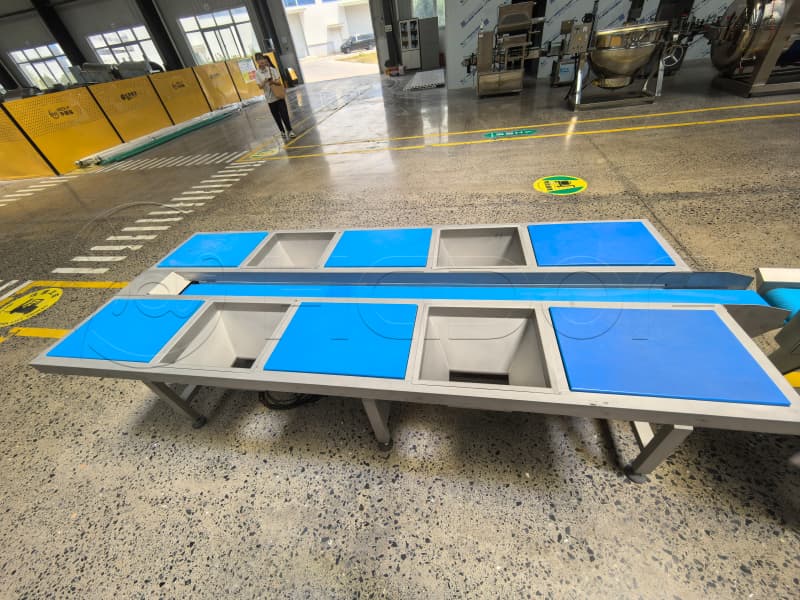
How Does a Six-Workstation Manual Cutting And Sorting Table Fit the Fresh-Cut Vegetable Processing Flow?
Food manufacturing plants place this equipment between a washing line and a cutting machine or between a cutting machine and a packaging line. Workers remove damaged leaves, rotten tissue, and foreign matter from cabbage, lettuce, spinach, broccoli, potatoes, onions, carrots, and sweet potatoes at each station. The single-layer structure uses one conveyor belt for material transport and manual sorting, so operators pick defective vegetables from both sides during food handling. A double-layer structure serves large food manufacturing projects, because the upper conveyor carries raw material while the lower conveyor removes finished product or waste. Each workstation includes a cutting board holder and a waste collection hole, so operators complete food preparation and waste management in one position.
Which Conveyor And Workstation Features Improve Vegetable Trimming, Sorting, And Food Processing Equipment Efficiency?
Six stations support six operators at the same time, and production capacity usually reaches 1.5 to 3 tons per hour depending on the raw material and product specification. The conveyor speed uses frequency control technology, so you can match the belt speed to a washing line, a cutting machine, or a packaging line. The SUS304 stainless steel structure resists corrosion, simplifies daily cleaning, and meets the hygiene requirements of international food production. A waste collection hole beside each cutting board reduces cross-contamination and keeps the inspection area organized. Manufacturers also connect a six-workstation vegetable inspection and sorting conveyor with automatic equipment, and the complete food processing system then runs with fewer stops and fewer quality issues.
What Configuration Should a Food Factory Choose for Manual Produce Inspection Stations and Food Processing Systems?
Food factories can choose 2, 4, 6, or 8 station configurations according to production budget, workshop layout, and daily output target. Small food workshops usually select 2-station or 4-station models, while large vegetable processing factories choose 6-station or 8-station systems. You can select a single-layer or double-layer conveyor structure, and you can request a food-grade produce trimming table with waste collection in a custom length and belt width. Many customers connect this inspection equipment with bubble cleaning machines, vortex washing systems, and automatic vegetable cutting machines, and this layout creates continuous food processing management from cleaning preparation to packaging procedures.
A leafy vegetable cutting equipment for fresh-cut vegetable lines can follow the sorting table, and the two machines work together to keep cut product clean and uniform. The food processing equipment supplier provides conveyor design, equipment layout planning, installation support, and complete line solutions for global food production projects. Workers must inspect leafy vegetables carefully before packaging to protect food safety and reduce waste.
Conclusion
In summary, a six-workstation manual cutting and sorting table creates a reliable inspection point for fresh-cut vegetable production. You can classify the configuration by workstation quantity, from compact 2-station units for small workshops to 8-station systems for large factories, and you can classify the structure by single-layer or double-layer conveyor design. The key decisions are belt speed control, food-grade material, cutting board holders, waste collection, and integration with washing and cutting equipment. When you plan a new ready-to-eat salad project or upgrade an existing vegetable processing line, this table gives your operators a stable platform for quality control. If you have interests, you can learn more about https://www.hadofps.com/products/manual-cutting-and-sorting-table/